
When Real Photos Tell the Wrong Story
Real photographs can mislead when their context changes. Cases from Gaza, Kyiv and Paris show what image provenance can establish and what still needs verification.
An old photograph shared after a new ceasefire shows how easily an image can acquire a different meaning, and why tracing its origins is only part of verifying the story it is used to tell.
In January 2025, a photograph of a crowd waving Palestinian flags circulated after news of a ceasefire in Gaza. Some social media posts drew attention to the people wearing T-shirts and light clothing, implying that the scene was recent. Full Fact noted that the posts may have been referring to reports of cold conditions and children dying from hypothermia in Gaza in the preceding weeks.1
The people in the picture were indeed celebrating a ceasefire, although the photograph belonged to an earlier round of fighting: AFP photographer Mahmud Hams had taken it in Gaza City on 21 May 2021, after an agreement ended 11 days of hostilities. Full Fact reported that the picture had also appeared with a recent caption in a third-party blog post on the Times of Israel website, and that the photograph was changed after it contacted the publication. The original version could not be independently inspected for this article.1 2
The words surrounding the photograph had moved a real crowd nearly four years forward in time, giving its light clothing a significance it could not support. Full Fact also linked to photographs of Palestinians celebrating the January 2025 ceasefire, making clear that the issue was which event this particular image documented.1
Similar shifts in context have carried photographs of airstrikes in Gaza into posts about attacks on Kyiv, while two pictures taken a week apart in Paris have been paired as if they revealed the same scene from different angles. Following these images back to their origins helps answer a question that goes beyond whether they were made by a camera: does the photograph support the claim attached to it?
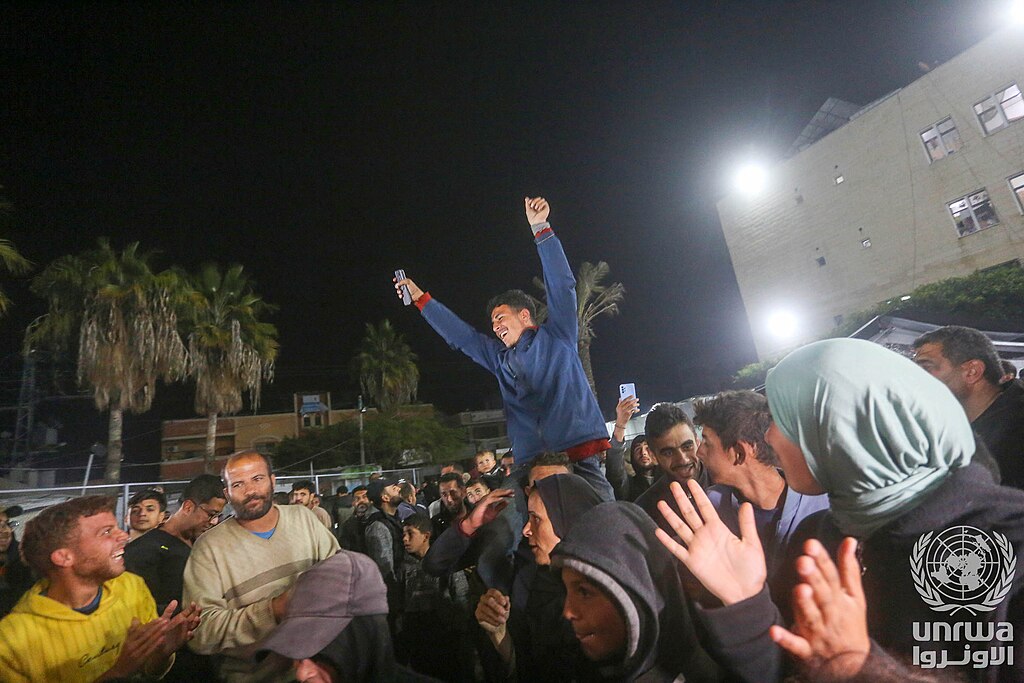
Palestinians in Deir el-Balah react to news of the ceasefire on 15 January 2025. This is a different photograph from the 2021 image discussed above. Photo: Ashraf Amra / UNRWA, via Wikimedia Commons; CC BY-SA 3.0 IGO, unmodified.

One city, two ceasefires
With its Palestinian flags and celebrating crowd in Gaza, the existing picture fitted the January 2025 news well enough for its date to be overlooked. Full Fact established the discrepancy by tracing it to the earlier ceasefire and linking to the Getty Images record, which credits Hams and dates the photograph to 21 May 2021.1 2
That date limits what can reasonably be inferred from the image: it documents an earlier celebration and offers no grounds for disputing either the celebrations after the 2025 announcement or reports of cold conditions at the time.1
A caption does not need to include a date for readers to connect an image to current events, as happened in May 2021 when a photograph of a distressed Palestinian girl carrying books circulated amid renewed fighting in Gaza. One post referred to children searching for books after Israeli bombing. AFP noted that the posts it examined did not specify which bombing they meant, but their timing suggested a connection to the ongoing violence.3
Reverse image searches led AFP to earlier appearances of the photograph and a watermarked copy bearing the name Fadi Thabet, who had written in a 2019 post that he took it in northern Gaza in 2014. He reiterated in May 2021 that the picture was old.3 USA Today located a 2018 Instagram post in which Thabet claimed the image; DW separately reported his account while noting that the photograph’s origin was not fully clear. 9 10
Because earlier copies and the photographer’s account remained available, fact-checkers could establish that the image predated the fighting surrounding its renewed circulation. A reliable capture date, attached to or recoverable for the version being shared, might have made that mismatch easier to identify, although its reliability would still depend on how the date was recorded and who or what vouched for it.
View the photograph and the misleading post in AFP’s fact-check.3
A picture of Gaza becomes a picture of Kyiv
On 24 February 2022, as Russia began its full-scale invasion of Ukraine, a Facebook post described an attack on Kyiv alongside a photograph of smoke rising over buildings. Other posts shared the same image or a second image of an explosion. AFP traced them to photographs by Mahmud Hams showing Israeli airstrikes in Gaza in 2021 and 2018.4 Colombiacheck independently traced two Gaza photographs attributed to Hams in a separate post about tensions in Ukraine published before the invasion. 12
Tracing these images revealed a change of place as well as time: photographs from Gaza had been used to illustrate an attack on Kyiv that they could not document, regardless of what was happening in the Ukrainian capital.4 In a separate 2022 post reviewed by Full Fact, two photographs were from Gaza while a third did show an explosion in Kyiv. Checking a collage therefore requires tracing its individual images, which may have very different histories. 11
The distinction is easy to lose when an image and a true news event travel together. A photograph can be a persuasive illustration of violence while failing to document the violence named in the caption. Finding an earlier publication or a photographer’s record can establish a useful contradiction; assessing what happened in Kyiv requires other evidence.
See AFP’s comparison of the posts and the original photographs.4
Two photographs, one invented connection
In December 2018, as yellow vest protests took place in Paris, a widely shared comparison paired a large fire near the Arc de Triomphe with a small burning toy scooter surrounded by people taking photographs. The juxtaposition suggested that journalists had turned an insignificant fire into a dramatic image through camera framing. AFP reported that one tweet carrying the comparison had been shared more than 35,000 times.5
View the comparison and the original context in AFP’s fact-check.5
Although similar views of the Arc de Triomphe made the comparison plausible, AFP traced the first photograph to Karine Pierre’s coverage on 1 December and the second to avenue de Friedland on 8 December, establishing that they showed separate incidents a week apart. AFP found no news image of the toy scooter presented as a fire in front of the monument, and could not establish whether the people photographing the scooter were journalists.5 6
The comparison depended on a connection between the images that their dates and locations contradicted, showing how access to trustworthy information about each photograph could help a reader test the claim. It would not, by itself, establish what the people in the second photograph did for a living or why someone chose to pair the pictures.
What a provenance record can — and cannot — establish
Content Credentials, based on the C2PA standard, are designed to bind statements about a digital asset to the asset itself, allowing information about its origin or subsequent edits to accompany it, depending on the tools and choices involved. A verifier can check that association and the integrity of the signed information, while deciding whether to trust the statements also requires considering who signed them.7 8
For the cases above, imagine that a relevant version of each photograph had carried a valid and accessible record containing a reliable capture date. The 2021 ceasefire picture could then be compared with the claim that it showed January 2025. Dates and reliable location information for both Paris pictures could help a reader see that they were not two views of the same moment. These are hypothetical examples: we have not established that the files circulated in these cases carried such credentials.
The record’s value depends on what it contains and how those statements were made. A signature can establish that a particular signer made a statement and that the protected information has not been altered; it cannot by itself ensure that a camera clock was correct, a location measurement accurate or a caption truthful. A signed image can still be accompanied by a misleading social media post. C2PA itself says provenance alone cannot determine whether a piece of content is factually true.7 8
Since credentials can be missing, removed or incomplete, their absence offers no basis for concluding that an image is fake, just as their presence leaves the question of context open.7 The difficulty of preserving context predates C2PA: in a 2019 test, the IPTC found that Facebook removed many fields from ordinary photo metadata while preserving some rights-related fields. That historical test concerned conventional metadata, not the survival rate of C2PA credentials today. 14
A 2024 NIST report surveys provenance alongside other approaches, including labelling and detection. 13 In a 2026 preprint, researchers examining C2PA’s security argue that it should not yet be relied on for high-stakes applications. That is the authors’ assessment, not a finding tested by this article; it illustrates why provenance systems themselves need independent scrutiny. 15
The work outside the frame
Across these cases, verification involved following the photographs beyond the posts in which they appeared. AFP found older copies of the girl’s photograph and the person who said he took it and, in the Paris case, checked the comparison against the dates, places and visual details of both scenes; Full Fact used an archive record to establish that the ceasefire image predated the posts.1 3 5
Each investigation combined information about the image with information from outside it. A better preserved provenance record could make some of those steps quicker and give readers evidence to inspect. It cannot decide what a photograph means in a new post, or whether a larger claim is supported by other evidence.
For the crowd photographed in Gaza in 2021, recovering the date was enough to break the connection to the 2025 ceasefire; understanding either event still required reporting beyond the photograph.
Sources
- Full Fact, Evie Townend, “Old photo of Palestinians celebrating shared as recent”, 21 January 2025. ↩
- Getty Images / AFP, Mahmud Hams, “Palestinian-Israeli conflict”, image 1233010933, created 21 May 2021. ↩
- AFP Fact Check, Ian Timberlake, “Photo of weeping Palestinian girl is not from latest conflict”, 18 May 2021. ↩
- AFP Fact Check, “Two old photos show Israeli airstrikes in the Gaza Strip, not Russia attacking Ukraine”, 25 February 2022, updated 4 March. ↩
- AFP Fact Check, Guillaume Daudin, “No, photos from ‘yellow vest’ protests were not framed by journalists to look more severe”, 12 December 2018. ↩
- Hans Lucas, Karine Pierre, “Gilets jaunes acte III”, series dated 1 December 2018. The public page identifies the series; identification of the exact frame relies on AFP.5 ↩
- C2PA, “C2PA and Content Credentials Explainer”, version 2.2, especially sections 2 and 7. ↩
- C2PA, “Content Credentials: Technical Specification”, version 2.5. ↩
- USA Today, “Fact check: Photo of Palestinian child in tears not from recent Israeli airstrikes”, 23 May 2021, republished by Yahoo News. Reports a 2018 Instagram post by the photographer; the original post was not independently inspected for this article. ↩
- Deutsche Welle, Rachel Baig and Tetyana Klug, “Children used as propaganda in Israel-Gaza crisis”, 18 May 2021. Attributes the 2014 date to Thabet and notes uncertainty about the image’s origin. ↩
- Full Fact, Pippa Allen-Kinross, “Photos claiming to show explosions in Ukraine are actually from Gaza”, 24 February 2022. Examines a separate three-image post, including one photograph of Kyiv. ↩
- Colombiacheck, “Publicaciones de ‘guerra en Ucrania’ usan dos fotos de ataques a Gaza”, 23 February 2022. A separate fact-check identifying two photographs attributed to Hams. ↩
- NIST, Bilva Chandra and colleagues, “Reducing Risks Posed by Synthetic Content: An Overview of Technical Approaches to Digital Content Transparency”, NIST AI 100-4, November 2024. ↩
- IPTC, “IPTC investigates: what does Facebook do with your photo metadata?”, 22 July 2019. Historical test of conventional EXIF, IPTC IIM and XMP metadata; not a current C2PA test. ↩
- Enis Golaszewski and colleagues, “Verifying Provenance of Digital Media: Why the C2PA Specifications Fall Short”, preprint version 1, 27 April 2026, examining specifications 2.2–2.4. Independent security assessment; its conclusions are the authors’ and should be evaluated against the version and assumptions studied. ↩