
The short road from Tehran's studios to your feed
Iran's first wartime fakes aimed for realism and were exposed within hours, at a visible cost to the state's credibility. Its latest wave does the opposite: openly artificial content, pushed through a wide and decentralised pipeline.
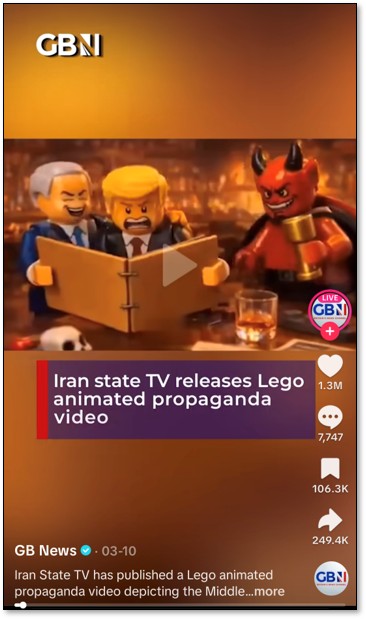
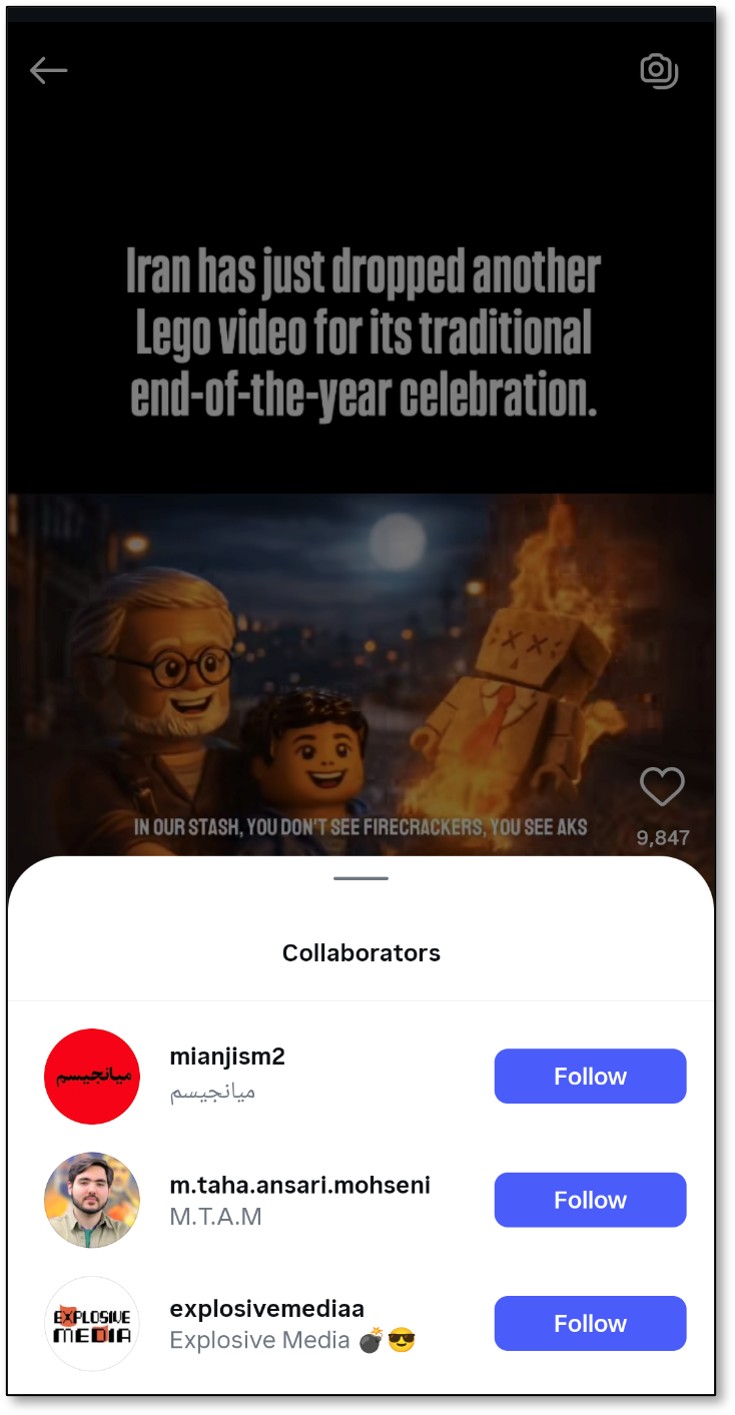
By 10 March 2026 Iran’s state broadcaster had aired a cartoon. A Lego-brick Donald Trump weeps over a folder marked “Epstein files”. Benjamin Netanyahu and the devil console him. He presses a red button, a missile hits a classroom of Iranian schoolgirls, and an officer lifts a small backpack from the rubble before the reprisals begin. The clip, “Narrative of Victory” by the Revayat-e Fath institute, was never meant to pass as footage.1 On 7 March a second Tehran outfit, Explosive Media, had switched from Farsi videos to English Lego animation. By the end of March, Canada’s Rapid Response Mechanism estimates, at least 83 million people had watched one of its clips.2
The Lego videos illustrate a pattern shared by every Iranian state-linked AI fake we traced since June 2025: the content moves through five stages, from studios tied to the state, to official outlets, to covert persona networks, to amplifiers that Tehran does not visibly direct, and finally to Western audiences and, occasionally, Western newspapers. We pieced together each stage to establish how it works and how far Tehran actually controls it.
We traced 54 instances in detail. The wider output is much larger: NewsGuard has logged 160 false claims about the 2026 war, running at two a day in its first month;13 the New York Times counted more than 110 pro-Iran deepfakes in the first fortnight, as cited by FDD;25 Cyabra found Lego-style clips posted from tens of thousands of accounts.31
Stage one: studios with ties to the state produce the content
The production layer is new to the 2026 war and is the part of the pipeline most firmly linked to the Iranian state. Two outfits account for the bulk of traced output. Revayat-e Fath, a state institute that reporters have linked to the IRGC, made the clip IRIB broadcast.1 Explosive Media made the viral series. It opened Telegram and Instagram accounts on 25 June 2025 and spent eight months producing Farsi videos with human presenters that few people watched; on 7 March 2026 it switched to English and to Lego figures. Within weeks the series included rap tracks, a fictional captured American pilot and missiles inscribed “In memory of the victims of Epstein Island”.2
Explosive Media’s state link rests on its own statements and on Canadian government analysis. The outlet calls itself independent and student-led, but its spokesman told the BBC that the government is a “customer”3 and told Al Jazeera that state outlets buy its work for broadcast.4 Canada’s Rapid Response Mechanism traced a credited collaborator on a 17 March video to Saeed Jalili’s 2024 presidential campaign media team, and assessed the operation as “likely linked” to Jalili, now the Supreme Leader’s representative on the Supreme National Security Council.2 YouTube banned the channel in April; Iran’s foreign ministry protested the ban.5
The studios mark a change of method. In 2025 the state’s fakes tried to pass as real footage:
- An image of F-35 wreckage, shown on state television and circulated by Tasnim on 14 June 2025, which BBC Verify’s Shayan Sardarizadeh judged “likely AI-generated” because the wing, exhaust and debris did not match the aircraft. (A separate video of the supposed shootdown, discussed below, came from unaffiliated accounts and was not AI at all.)6,7
- A Tehran Times clip captioned “Doomsday in Tel Aviv”, showing the city in ruins from above. Factnameh traced it to an Arabic social media account that specialises in AI “fantasy destruction”; the post stayed up after a Community Note was added.8
- A “Tel Aviv before and after” video that appeared at the same moment on state broadcasters, semi-official agencies and reformist dailies such as Shargh, creating what Factnameh called “the illusion of independent verification”.9
The 2026 Lego content, by contrast, is visibly artificial and persuades through narrative and pop-culture reference instead.
Stage two: official outlets publish fakes under their own names
The second stage is overt: state media and diplomatic accounts post AI-generated material under their own names, which makes this the most securely attributed layer. In the first 72 hours of the 2026 war:
- The Tehran Times posted a “before and after” satellite collage of a “completely destroyed” US radar in Qatar. Correctiv found that one frame was manipulated and the other showed a US naval base in Bahrain, drawn from 2025 Google Earth imagery.10,35
- The Iranian Embassy in Austria posted a blood-stained child’s backpack to illustrate the real strike on a school in Minab. Google’s SynthID detector confirmed the image was made with Google’s AI,11 and the fake was then used by others to cast doubt on the real attack.10
- An AI video of a Bahrain tower in flames circulated on accounts associated with the Iranian government, AP found;12 Press TV posted and later removed it.36
NewsGuard counted eighteen false war claims from Iranian sources in those first days, against five in the fortnight before.14 Yet the same organisation’s broader finding is that the state is a minor contributor to the total volume of false content about the war.
While pro-Iran claims have dominated NewsGuard’s database, only a handful were originated by Iranian state media.
Stage three: covert networks give the content false authors
The third stage hides the source. Fake accounts and invented people carry state narratives to audiences that would not trust a Tehran byline; this is where AI has changed working methods most. Three kinds of network appear in the register.
- Social media personas. Clemson University’s Media Forensics Hub identified an IRGC-affiliated network of 61 accounts on X, Instagram and Bluesky. It grew out of a network Clemson had first seen in 2024 posting about Scottish independence, and switched to war propaganda within 24 hours of the first strikes. Its posting metadata pointed to an “Iran Android App”, and its imagery matched at least six Iranian embassy pages.15 Meta removed 294 Iran-based Instagram accounts in March16 and 35 more in August; the second group posed as American activists and posted memes, some AI-generated, to about 79,000 followers.17
- Hebrew-language personas aimed at Israelis. FakeReporter tracked accounts that spread deepfakes and doctored clips of Netanyahu fleeing the country during the 2025 war.18 In September 2026 the research firm Golden Owl mapped 35 Israeli-presenting personas, tied to Iran by app data, that drew about 950,000 views inside the election debate.19
- Fake journalists in real publications. On 8 October OpenAI disclosed “Bogus Bylines”: seven invented Western journalists who placed nearly 100 AI-polished articles about the war in small and mid-sized international-affairs outlets, starting in July 2025 and accelerating after February 2026. OpenAI rated the placements Category 4 on its six-point Breakout Scale, two levels above the Category 2 it gave the same operation’s social media comments. It confirmed the accounts originated in Iran and said it could not identify who ran them.20,21
Stages four and five: outsiders carry the content to its audiences
The final stages are mostly outside Tehran’s direct control, and they are where the content gains its reach. Canada’s analysis of the Lego videos makes the division clear: RT and Iranian state accounts pushed the clips in their first twelve hours, yet accounts located in Russia or Iran supplied only about 4 per cent of March views; the rest came through platform recommendation feeds, above all TikTok’s.2 ISD found two coordinated pro-Iran networks on X, of roughly 20 accounts each, that drew more than a billion views in the war’s first month by buying blue ticks and reposting each other’s AI clips. Iranian embassies in South Africa and Australia reshared their posts, but ISD found no evidence that the networks themselves were state-run.22
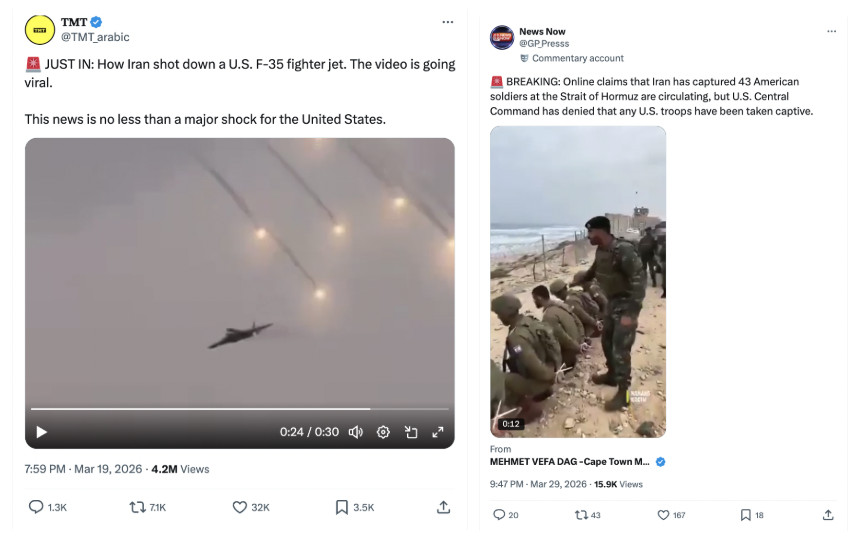
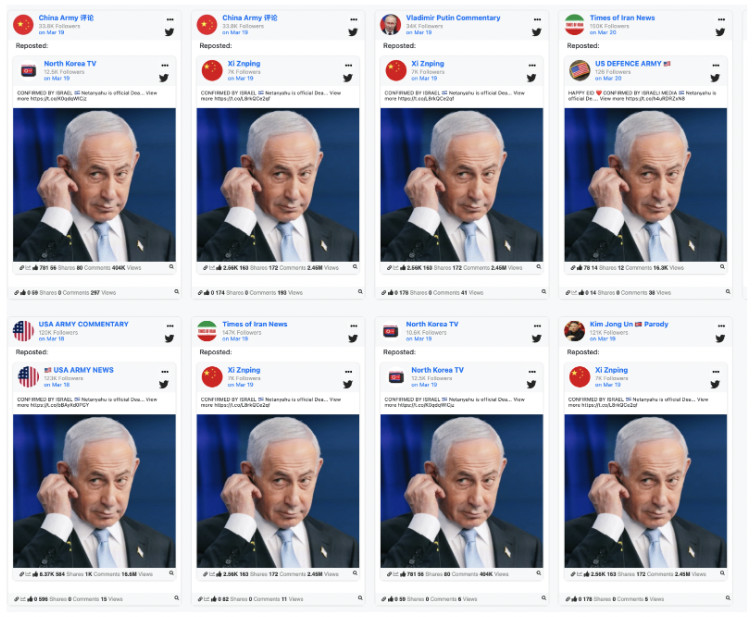
Because this stage is open to anyone, the fakes that travelled furthest are often the ones that cannot be traced to Iran at all. A video of the USS Abraham Lincoln burning, posted by an X account claiming to be Iranian press, was convincing enough that Trump said he called his generals before posting that the ship “was not even shot at”.23 No one has attributed that clip to Tehran. Several other widely shared “Iranian AI fakes” were neither Iranian nor AI:
- The video of an Israeli F-35 being shot down, with 21 million TikTok views, was flight-simulator footage posted by unaffiliated accounts. It is distinct from the AI wreckage image on state television.24
- Thirty-one hacked “Iran War Monitor” accounts belonged to a Pakistani individual, according to X.32
- A deepfake of the Evin prison bombing was traced by Citizen Lab to an Israel-linked network.26
- The most prominent pro-Iran account of the 2025 war, “Daily Iran Military”, had “no obvious ties to authorities in Tehran”, BBC Verify found.24
The fakes Tehran did make have carried a cost. In December 2025 the head of IRIB, Peyman Jebeli, conceded that the F-35 shootdown reports were “not reliable” and had damaged the broadcaster’s credibility.27
What the pipeline is for
The purpose of the fakes shifted between the two wars. In 2025 they served morale and deterrence at home: downed jets, Tel Aviv in ruins. In 2026 they were aimed outward, in English, at the divisions of American politics, and inward at a succession crisis. IranWire reports that every public visual of the new Supreme Leader, Mojtaba Khamenei, has so far been AI-generated, with his messages delivered as voice-overs.28 Factnameh judged a viral August video of him meeting President Pezeshkian “likely AI-generated”.29 AI has become a substitute for a leadership that does not appear in person.
The underlying capability has not been transformed. Recorded Future’s assessment of the 2026 conflict is that AI “very likely accelerated existing Iranian capabilities… rather than creating new ones”.30 OpenAI reached the same conclusion about Bogus Bylines, which it said “closely resembled complex influence operations of the pre-AI age”.20 The studios are new, the Lego bricks are new, the fake journalists write faster. The road they travel, and the outsiders who carry them down it, are the old ones.
Sources
- Adnkronos, “Iran, Tehran’s ‘Lego’ propaganda, video shows Trump and Netanyahu with the devil”, 10 March 2026. english.adnkronos.com ↩
- Global Affairs Canada, Rapid Response Mechanism, “Explosive Media: Iranian state-linked AI Lego-style videos claiming that Tehran has ‘won the propaganda war’”, issued 11 May, updated 10 July 2026. international.canada.ca ↩
- Jerusalem Post, “‘The regime is a customer’: BBC interviews activist behind pro-Iran Lego propaganda videos”, April 2026. jpost.com ↩
- Al Jazeera, “‘Vengeance for all’: How Iran’s Lego videos won narrative war against Trump”, 17 April 2026. aljazeera.com ↩
- Al Jazeera, “Iran slams YouTube ban on pro-Iranian group’s Lego-style AI videos”, 14 April 2026. aljazeera.com ↩
- Shayan Sardarizadeh (BBC Verify), post on X, 14 June 2025. x.com ↩
- France 24 Observers, “No definite proof for Iran’s claims it shot down Israeli F-35 fighter jets”, 24 June 2025. france24.com ↩
- Factnameh for EDMO, “The First AI War: How the Iran-Israel Conflict Became a Battlefield for Generative Misinformation”, 2026. edmo.eu ↩
- Factnameh, “The 12-Day Conflict: An Analysis of Iran’s Disinformation Landscape”, 2025. factnameh.substack.com ↩
- PolitiFact, “How Iran conducts influence operations”, 23 March 2026. politifact.com ↩
- EBU Spotlight, “AI on the frontlines: How fakes are going viral amid new Middle East war” (citing VerificaRTVE), March 2026. spotlight.ebu.ch ↩
- Associated Press (via Yahoo News), “State actors are behind much of the visual misinformation about the Iran war”, March 2026. yahoo.com ↩
- NewsGuard, “2026 Iran War False Claims Tracking Center”, updated 25 September 2026. newsguardtech.com ↩
- Euronews, “Iran’s state media ramps up disinformation campaign as the US-Iran conflict wages”, 6 March 2026. euronews.com ↩
- Murray, Linvill and Warren, Clemson Media Forensics Hub, “From Texas to Tehran: A Multilingual, IRGC-affiliated Influence Operation on X, Instagram, and Bluesky”, 11 March 2026. open.clemson.edu ↩
- Meta, threat indicators, “H1 2026 Iran-based CIB network”, 2026. github.com/facebook/threat-research ↩
- Axios, “Iranian operatives used AI to impersonate Americans”, 27 August 2026. axios.com ↩
- Ynet, “Without firing a single shot: Iran’s propaganda war to destroy Israel from within” (FakeReporter report), 8 July 2025. ynetnews.com ↩
- Golden Owl, “The Other Face of War: Iranian Regime–Linked Manipulation of Israel’s 2026 Election Debate”, September 2026. goldenowl.ai ↩
- OpenAI, “Disrupting AI-enabled ‘false front’ operations”, 8 October 2026. openai.com ↩
- Iran International, “Iran-origin campaign targeted Iran International, foreign media – OpenAI”, 9 October 2026. iranintl.com ↩
- Institute for Strategic Dialogue, “How pro-Iran networks gained a billion views on war propaganda”, 15 April 2026. isdglobal.org ↩
- Euronews, “How misinformation and AI deepfakes on social media are reshaping the Iran war”, 30 March 2026. euronews.com ↩
- BBC Verify, “Israel-Iran conflict unleashes wave of AI disinformation”, 20 June 2025 (republished by APA). en.apa.az ↩
- Foundation for Defense of Democracies, “Deepfakes on the Front Lines: Iran’s AI Disinformation Campaign” (citing New York Times count), 19 March 2026. fdd.org ↩
- CyberScoop, “Researchers say Israeli government likely behind AI-generated disinfo campaign in Iran” (Citizen Lab, Clemson), October 2025. cyberscoop.com ↩
- Iran International, “False report on downing Israeli F-35 hit credibility, state TV chief says”, 10 December 2025. iranintl.com ↩
- IranWire, “AI Video Shows Mojtaba Khamenei ‘Riding Taxis with the People’”, 17 April 2026. iranwire.com ↩
- Factnameh, “Monthly Brief: August 2026”. factnameh.substack.com ↩
- Recorded Future, Insikt Group, “AI Has Enhanced Iran’s Asymmetric Playbook During the 2026 Conflict”, 16 July 2026. recordedfuture.com ↩
- Cyabra analysis as summarised in Wikipedia, “Explosive Media” (145 million views from tens of thousands of accounts), accessed 11 October 2026. en.wikipedia.org ↩
- Wikipedia, “Misinformation during the 2026 Iran war” (citing NDTV and Times of India on Nikita Bier’s statement), accessed 11 October 2026. en.wikipedia.org ↩
- Factnameh, “Iran’s Information War: Patterns and Trends in Information and Narrative Manipulation”, 5 April 2026. factnameh.substack.com ↩
- PolitiFact (citing Full Fact), “These videos don’t show US strikes in Iran and counterattacks”, 2 March 2026. politifact.com ↩
- Correctiv.Faktencheck, “Krieg in Iran: Tehran Times teilt gefälschte Satellitenaufnahme von angegriffener US-Basis”, 2 March 2026. correctiv.org ↩
- The Media Copilot, “Iran floods the zone with AI war propaganda. Journalists can’t keep up”, March 2026. mediacopilot.ai ↩